

Plan ahead. Protect your timelines - Customer Advisory | Mid June 2026
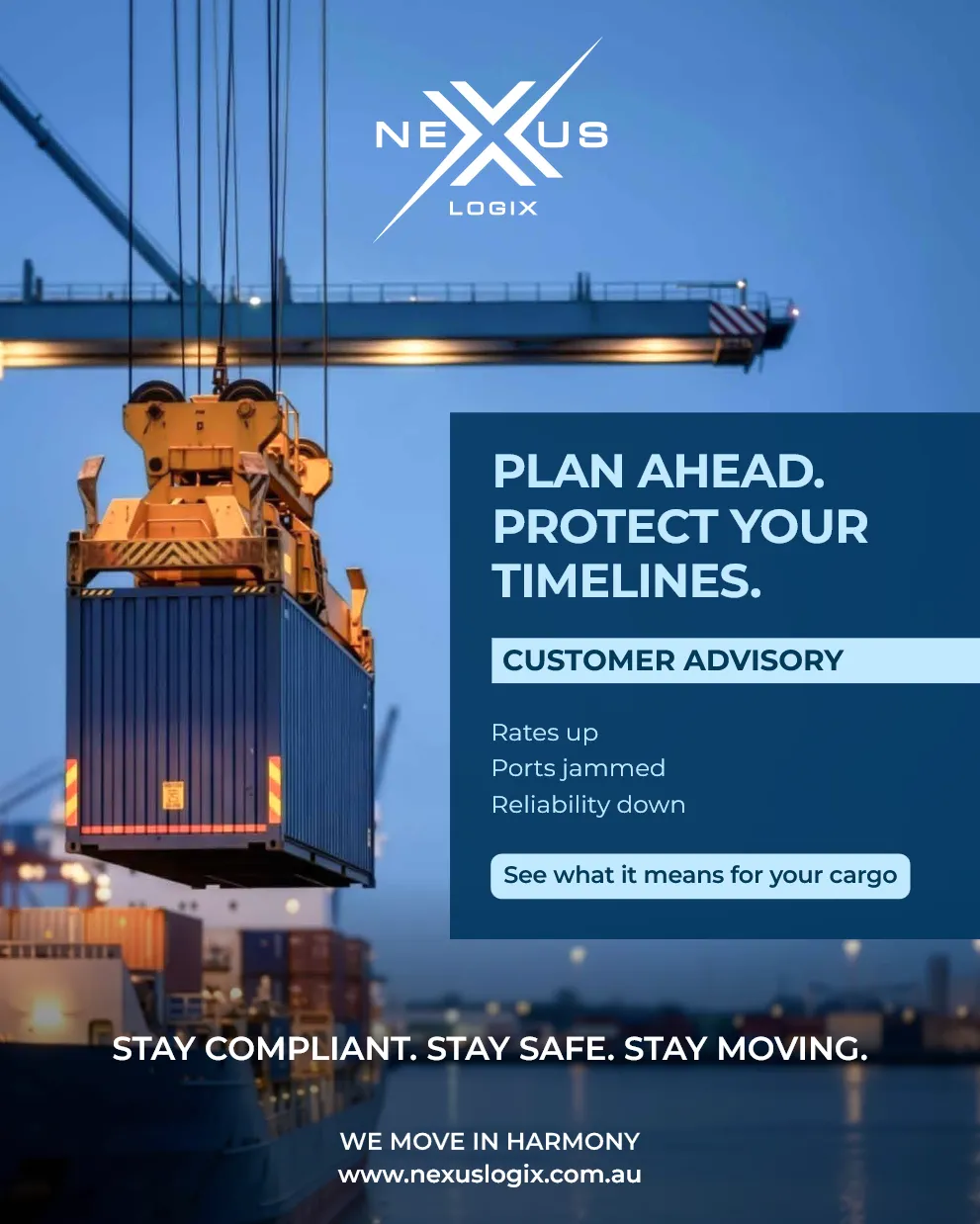
Your China shipment may still sail, but will it arrive when your customer needs it?
For Australian importers, the issue is no longer just freight rates.
The China to Australia container market is entering a tighter period, with vessel delays, space pressure, and stronger rate movements now becoming more evident across key China export ports.
This should now be treated as a space and schedule risk period, not simply a freight rate negotiation period.
Further to our Nexus Logix LinkedIn update on 29 May 2026, market conditions have continued to shift.
Drewry’s World Container Index has jumped 23%, while the broader containerised freight index has increased by nearly 40% over the past month. This points to a clear upward rate cycle, supported by an earlier-than-usual peak season and tightening vessel space.
What Australian importers should allow for:
Normal direct China to Australia transit is typically around 14–22 days, depending on the origin and destination ports.
For the next 8–10 weeks, planning transit times should be treated more conservatively:
- Shanghai / Ningbo to Sydney / Melbourne: 21–29 days
- Qingdao / Tianjin to Australia: 25–33 days
- Yantian / Shekou / Nansha to Australia: 18–27 days
- Hong Kong to Australia: 16–23 days
The strongest pressure is likely to be felt from South China ( Yantian, Shekou, and Nansha) and East China origins (Shanghai, Ningbo, Qingdao, Tianjin), where space shortage, port delays, and container rolling risk are becoming more visible.
For importers with retail, promotional, seasonal, or project cargo, this is the time to plan ahead, especially where stock availability, customer commitments, or launch dates are at risk.
Our recommendation:
Book at least 3–4 weeks ahead of cargo readiness. Where cargo is time-sensitive, speak with your freight forwarder about splitting shipments across carriers, services, or origin ports to reduce the risk of delay or rollover.
At Nexus Logix, we are working closely with our carrier and network partners to help customers secure space, manage routing options, and protect delivery timelines.
This Insights may also be of interest to you.
Freight Market Update - September 2026
The Asia to Australia freight market is entering September with one clear message for importers: the market is manageable, but only if planning starts early.
Freight Market Update - October 2026
Asia to Australia freight enters October with an unusual combination: port queues at major Asian gateways are easing, but global schedule reliability has fallen to its weakest level in four years.
Freight Market Update - August 2026
Rates are levelling off. Space, schedule and destination port risk have not.

Read the Game - Winning Against Detention and Demurrage
Demurrage runs while your container sits at the port. Detention runs once it leaves. Two clocks, both costing you money, and most importers only find out when the invoice lands.
